|
|
|
Schmidt Hammer Lassen designed a new library building for the University of Aberdeen campus in Aberdeen, Scotland. Photo: Adam Moerk
|
The Royal Incorporation of Architects in Scotland (RIAS has announced 12 winners of its RIAS Awards for 2013. In addition to winners in its main awards section, as it continues to evolve the program, RIAS also announced three new sponsored topical subcategories for use of timber, for sustainability, and for resource efficiency.
The RIAS Awards 2013 winners are:
|
|
Photo: Paul Zanre Photography
The Beacon Arts Centre, Greenock, Scotland
LDN Architects
Client: Greenock Arts Guild
"This building seems wholly appropriate for its superb waterside setting. It is elegantly contemporary in its materials and form, both open and welcoming.
|
|
|
The fourth phase of the Skirball Cultural Center, under construction in Los Angeles, California will open in October 2013. Image: Courtesy Skirball Cultural Center
|
Construction continues on the fourth and final phase of the Skirball Cultural Center in Los Angeles, California, set to open in October 2013. The thirty-year project has been masterplanned and designed by Moshe Safdie.
This phase of the development will feature two adjoining buildings – Herscher Hall and Guerin Pavilion – on the north side of the campus. These facilities will provide additional space for the Skirball's programming, including the addition of 40,000 square feet of classrooms, conference spaces, gardens, and a grand hall accommodating up to 1,200 guests. The 9,000-square-foot (840-square-meter) grand hall is daylit by nearly 100 custom skylights in a roof supported by Oregon Douglas Fir beams.
|
|
Interior rendering of the great hall and its window wall. Image: Courtesy Skirball Cultural Center
|
A large window-wall frames a view of the cascading terraced courtyard garden, which contains 30 Japanese maple trees. And the entrance plaza to the new building is accented with coral trees, enamel art panels, and a fountain.
The campus building palette comprises pink Tadoussac stone, recessed glazing, stainless steel roofs, vaulted ceilings, and discreet planted areas.
|
|
The Chapel of Saint Albert the Great, in Edinburgh, Scotland was designed by Simpson and Brown. Photo: Chris Humphreys
|
From a beautifully-crafted chapel in the back garden of an Edinburgh townhouse to the yellow-roofed Ferrari Museum in Italy, and from a new 'green' flagship store in Cheshire, to a new visitors center at the Giant's Causeway in Northern Ireland, a total of 52 projects throughout the United Kingdom and European Union are winners of the 2013 RIBA National Awards.
|
|
Shiro Studio inherited the design of the yellow-roofed Ferrari Museum, in Modena, Italy following the death of Jan Kaplický. Photo: Studio Cento29
|
According to RIBA (the Royal Institute of British Architects), one third of this year's UK winners are education buildings. And fewer medium-scale projects won this year, although large- and small-scale projects are well represented. Many of the winners are publicly, charity, or foundation funded, with only one commercial office building in the mix.
|
|
A major renovation of the Park Hill estate housing complex was designed by Hawkins Brown & Studio Egret West. Photo: Daniel Hopkins
|
|
|
Norman Foster designed a two-story addition, and major renovation of the existing 19th-century core of the Lenbachhaus Museum, in Munich, Germany. Photo: Nigel Young/ Foster + Partners
|
In Munich, Germany, the Lenbachhaus Museum has reopened with a major new golden addition, and extensive renovations designed by Foster + Partners. Originally built in 1891 as a studio and villa for the artist Franz von Lenbach, the Lenbachhaus Museum was gradually extended over the last century as its audience grew to some 280,000 annual visitors.
|
|
Section drawing. Image: BPR/ Foster+ Partners
|
To accommodate these growing numbers, the building's facilities and circulation have been significantly improved. A new building entrance was created and is served by a new piazza to the east of the museum. This move helped to reclaim the villa's courtyard garden as a place of contemplation, separate from the main circulation system.
|
|
Inside the atrium of the Lenbachhaus Museum. Photo: Nigel Young/ Foster + Partners
|
The new social heart of the building is a dramatic top-lit atrium, with ticket and information desks, access to a new temporary exhibition space on the ground floor, and a grand, cantilevered stair leading to the upper level galleries. This large-volume space incorporates a portion of the original villa wall and is intended to accommodate large-scale works of art.
|
|
Construction has begun on an 11-story expansion to the SFMOMA building in San Francisco, California designed by Snøhetta. Image: Courtesy Snøhetta
|
Construction has begun on the new 235,000-square-foot (22,000-square-meter) expansion of SFMOMA in San Francisco, California. Scheduled for completion in 2016, the 11-story structure was designed by Snøhetta. Until the building's reopening, SFMOMA will be staging exhibitions and other events at locations througout
|
|
SmithGroup JJR designed the new LEED Platinum-targeting University of Utah College of Law building which is under construction in Salt Lake City, Utah. Image: ©VCBO/ SmithGroup JJR Architecture/ College of Law
|
Ground has broken on the S.J. Quinney College of Law building on the campus of the University of Utah, in Salt Lake City. In addition to providing more typical facilities the 155,000-square-foot (14,400-square-meter) building will provide space needed by the college for hands-on training of lawyers including practice courtrooms, and a collaborative research facility, as well as facilities to support the school's tradition of providing pro bono services to the community.
With upper levels projecting beyond a double-height ground floor, the five-story building will feature a predominantly glazed facade, with vertical and horizontal shades to minimize heat gain. Opaque facade materials will include metal, concrete, stone, and an orange-colored panel system that helps to frame and visually unify the disparate glazed volumes of the building's several wings.
|
|
Rear overview of Quinney building. Image: ©VCBO/ SmithGroup JJR Architecture/ College of Law
|
|
|
Caption. Photo: Arthur Bagen
|
A major reskinning and renovation project on the campus of Eindhoven Technical University (TU/e) in Eindhoven, the Netherlands, converted a derelict boiler plant into the inviting and energy-efficient home of the school's Institute for Complex Molecular Systems (ICMS). Once clad in brick, Boiler House Ceres now has a predominantly glazed curtain wall that connects the two-story building with the surrounding campus.
Diederendirrix Architects designed the transformation, which preserved the building's steel structure, central light monitor, and other industrial details including a large sliding door, even as the building's envelope and systems were substantially upgraded. The building is the 2013 recipient of the annual Royal Institute of Dutch Architects Building of the Year award.
|
|
The central light monitor now encloses a central atrium and circulation space. Photo: Arthur Bagen
|
|
|
The new Jesse S. Jackson Sustainable Winery in Davis, California, was designed by Siegel & Strain Architects. Photo: Courtesy Guttmann & Blaevoet Consulting Engineers
|
The new Jess S. Jackson Sustainable Winery Building (JSWB) has opened on the campus of UC Davis, in Davis, California. The 8,500-square-foot industrial building is the result of a design-build collaboration between Siegel & Strain Architects and Pankow Builders. The JSWB will house teaching and research facilities for winery, brewery, and food-processing activities.
Thanks to a five-kilowatt photovoltaic array, which can be expanded to 30 kilowatts to support future increases in energy needs, the building is expected to operate at a "net-zero" energy level. This is achieved with a series of aggressively sustainable passive systems, including a tight, super-insulated building envelope, and substantial thermal mass, including a concrete slab, CMU stub walls, and a future rock bed, that supports a night-ventilation cooling strategy.
|
|
Interior of the JSWB. Photo: Courtesy Guttmann & Blaevoet Consulting Engineers
|
|
|
A new atrium and interior structure replaced the original book storage structure inside the north wing of the St. Louis Central Library, renovated by Cannon Design. Photo: © Timothy Hursley
|
A major renovation of Cass Gilbert's Central Library building (1912) in St. Louis, Missouri is one of six projects to receive a 2013 AIA/ALA Library Building Award. The transformation focused on modernizing the facility and improving public access. Cannon Design restored the library's Great Hall and four surrounding wings, while at the same time significantly adapting a fifth wing and creating a new atrium.
This adaptation involved removing a cramped book storage structure and replacing it with new, more generously proportioned spaces that seem to float within the building's original envelope. Use of glass balustrades throughout this wing, and improvements to glazing on the north wall result in a light open and inviting space.
|
|
Rapson's second-place design for a 1950 NAHB competition. Image: Ralph Rapson
|
In 1950, the National Association of Home Builders held a nationwide housing competition for a small 1,000-square-foot house plan tailored to a particular region of the country. Amazingly, the competition drew some seven thousand entries, making it the largest competition in its day.
The rules permitted only one entry per person, but since I had worked out two designs, I decided to enter one in Mary's name. At the last moment. I flipped a coin to decide how to credit the designs.The entry submitted under my name received second national overall prize and first prize for homes designed for the southeast region.
|
|
| The Lakeview Library is one of three remodeled by RDH Architects. Photo: Tom Arban
|
The Mississauga Library Project is an adaptive re-use strategy recently completed upgrades and additions to the Lakeview, Port Credit, and Lorne Park branch libraries, in Mississauga, Ontario. Toronto, Ontario-based RDH Architects Inc. designed the building renovations.
The three library projects date from between 1956 and 1967 and the three renovations were treated as one project, a strategy put forth by the client as a means to use public infrastructure stimulus funds in an efficient manner.
|
|
Overview of the Lakeview Library. Photo: RDH
|
Each of the libraries is situated in park settings. Lakeview and Lorne Park stand within established 1950's suburban neighborhoods, while Port Credit is situated adjacent to the Credit River along Lakeshore Road, the former commercial 'high' street of the old town of Port Credit.
|
|
Caption. Image: RDH Architects
|
The libraries are mid-century modern buildings with similar physical and aesthetic characteristics. As such, the new design for the buildings is based on the development of a single vocabulary of consistent parts, applied differently to each of the three libraries.
The result is the transformation of three tired modern facilities: a complete gutting of the interiors, a re-cladding and expansion of all glazed areas, the refurbishment of exterior masonry, and the development of a canopy frame system and set of exterior terraces intended to change the building aesthetics.
|
|
Lorne Park Library. Photo: RDH
|
The existing exterior elevations of each library are composed as a basic rhythm of solid and void. The solid areas are predominantly masonry while the voids areas are glazed. This composition was respected and accentuated by increasing the amount of glazing in each void area, extending the glass from floor to ceiling and using a minimal detailing methodology.
The new steel frame canopy systems form an enclosing colonnade that incorporates the existing building volumes and engages with the park setting while providing infrastructure for building elements such as canopies, shading, lighting, and plants. Custom ceramic frit patterns reinforce the vertical rhythm of the colonnade.
|
|
Port Credit Library. Photo: Tom Arban
|
The buildings' new interiors emphasize openness and transparency. Where walls between public spaces are required, most are made of structural glass. Low shelves and an open plan design also contribute to a sense of interior spaciousness in these modest branch facilities.
|
|
Port Credit floor plan drawing. Image: RDH Architects
|
Project Details
- Buildings:
- Lakeview Library, 1110 Atwater Ave, Mississauga, Ontario, Canada
- Port Credit Library, 20 Lakeshore Road East, Mississauga, Ontario, Canada
- Lorne Park Library, 1474 Truscott Drive, Mississauga, Ontario, Canada
- Date of Occupancy: Jan. 2011
- Construction Budget: $8,900 000.00
|
|
Glazed partition walls inside the Port Credit Library. Photo: Tom Arban
|
Project Credits
- Architect: RDH Architects Inc.
- Client: Mississauga Public Library
- Landscape Architect: NAK Design
- Structural Engineers: Halsall Associates Ltd.
- Mechanical / Electrical Engineering: Jain Associates Ltd.
- Civil Engineers: Valdor Engineering Inc.
- Contractor: Brown Daniels Associates
|
|
Lorne Park Library floor plan drawing. Image: RDH Architects
|
 |
| Inside the Lakeview Library. Photo: Tom Arban |
 |
| Inside the Lorne Park Library. Photo: Tom Arban |
|
|
Inside the Port Credit Library. Photo: Tom Arban
|
|
|
Rooftop vegetable gardens are a part of the Via Verde affordable housing development, in Bronx, New York, designed by Dattner Architects and Grimshaw Architects. Photo: David Sundberg/ Esto
|
The winners of the 2013 national AIA Housing design awards include four high-end private residential projects in Washington, California, Colorado, and Texas, an affordable housing project in Bronx, New York, and a 1,650-student housing development in Seattle, Washington.
Via Verde is a 222-unit affordable living development built on a former brownfield site in Bronx, New York. Designed by Dattner Architects and Grimshaw Architects, the project combines high-rise, mid-rise and townhouse residential structures unified by a common color scheme that includes bright red, orange, and yellow highlights.
|
|
BCJ designed the Halls Ridge Knoll Guest House, in San Francisco, California. Photo: Nic Lehoux
|
Bohlin Cywinski Jackson's contribution to the single-family housing category is the latest in a long line of thoughtfully modern luxury dwellings incorporating the firm's signature moves – copious glazing, a rigorous and logical timber structure, and living spaces that blend indoor and outdoor spaces. The Halls Ridge Knoll Guest House, located in San Francisco, California is a simple shed-roof structure sited among oaks on a sloping lot, surrounded by a generous deck, adjacent to a large swimming pool.
A complete list of the winners includes:
|
|
Photo: Will Austin
Eagle Ridge; Eastsound, Washington
by Gary Gladwish Architecture
|
|
|
Photo: Steve Mundinger
House in the Mountains; Colorado
by GLUCK+
|
|
|
Photo: David Sundberg/ Esto
Via Verde - The Green Way; Bronx, New York
by Dattner Architects and Grimshaw Architects
|
|
|
Photo: Benjamin Benschneider
West Campus Housing - Phase I; Seattle
|
The jury comprised: Kathleen Dorgan, AIA, Dorgan Architecture & Planning; John Isch, AIA, RWA Architects, Inc.; R. Thomas Jones, AIA, California Polytechnic State University; Stephen Sharpe, Hon. AIA and Charles L. Travis, AIA, The Housing Studio, P.A.
"The arts, including architecture, have always played a basic role in Finland's cultural history. The harsh Nordic climate demands special awareness of materials, energy, and light. Nature is central and buildings are placed into the landscape with great care."
"Unfortunately, my time in Finland, with its lush virgin countryside, endless lakes, and magical green forests, was somewhat limited. Even so, I was able to witness people's love and respect for their land and their love of beauty and quality – in both nature and human-crafted design. Helsinki, the nation's capital and largest city, is wonderfully modern. Everywhere, the architecture is uncluttered and functional, pure, and often beautifully understated."
|
|
The Monplein housing development by Tony Fretton Architects has been completed in Den Helder, Netherlands. Photo: Christian Richters
|
A 3,200-square-meter (34,000-square-foot) multiunit mixed-use residential development has been completed in Den Helder, Netherlands, on a site between two canals and overlooking a former Napoleonic naval yard.
Commissioned by Dutch developer Proper-Stok, the Monplein development comprises two- and three-story dwellings designed by Tony Fretton Architects with Geurst en Schulze Architecten in a full-city revitalization masterplan by West 8.
The formerly vacant site is a single, irregularly shaped block that resembles a boot in plan. Units are arranged at the perimeter of the block, defininig a series of private outdoor spaces in the center. On one side of the block, rows of narrow townhouses form unbroken walls onto the streetscape with a familiar Dutche residential scale and rhythm.
|
|
Rowhouses of the Monplein development. Photo: Christian Richters
|
On the block's other long side, larger separated dwellings form an alternating rhythm of solid and void. At the boot's bottom, a large five-sided open space is ringed by an array of mixed-use buildings.
Hagia Sophia, in Istanbul, Turkey, designed by Isidoros and Anthemios, 532 to 537.
Color sketch by Ralph Rapson, from Ralph Rapson Sketches and Drawings from Around the World, courtesy of the Afton Press.
"I may be one of the few people who have seen Istanbul and the Straits of Bosporus from atop a minaret. I'd long wanted to see the Hagia Sophia, once a mosque, a Christian church, and now a museum, and when I suggested to a guide I'd met in the streets that I'd like to see the city from one of the towers, he miraculously found a way For twenty dollars, I not only had several meals and a day's worth of touring, but I also got to see the city's narrow, jostling streets and port from one of its finest vantage points." – Ralph Rapson
 |
| Overview of Istanbul, Turkey. Image: Ralph Rapson |
|
|
308 Mulberry Street in Lewes, Delaware, by Robert M. Gurney Architect. Photo: Maxwell MacKenzie
|
Robert M. Gurney Architect redesigned and significantly expanded the house at 308 Mulberry Street in Lewes, Delaware, to create a luxury residential compound that emphasizes outdoor living. The original one- and three-story shingled home has neoclassical proportions and detailing that has been meticulously restored. Four outbuildings are located in the rear of the home and, together with the main house, enclose three sides of an outdoor living space dominated by a patio and swimming pool.
The building was a recipient of the 2013 AIA national Small Project Awards in the category.
|
|
Looking from the breezeway along the living pavilion toward the historic dwelling. Photo: Maxwell MacKenzie
|
Besides a formal entry and classic double-angle stair, the three levels of the historic home contain the bedrooms and their supporting spaces. A large master suite occupies around two-thirds of the ground floor, with french doors that open onto the rear patio. Two modest bedrooms and a bathroom are found on the second level.
And tucked under the main gable is a fourth bedroom with an all-glass interior end wall, two skylights overlooking the back yard, and with bathroom functions split into two small adjoining spaces.
|
|
The top-floor bedroom of 308 Mulberry Street. Photo: Maxwell MacKenzie
|
 |
Thomas Phifer and Partners designed an addition to the Lee Hall College of Architecture at Clemson University. Photo: Scott Frances
|
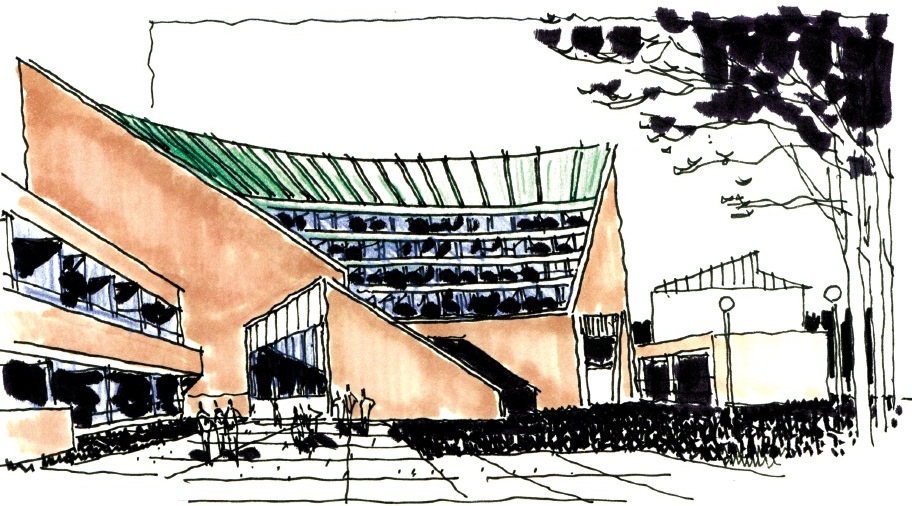
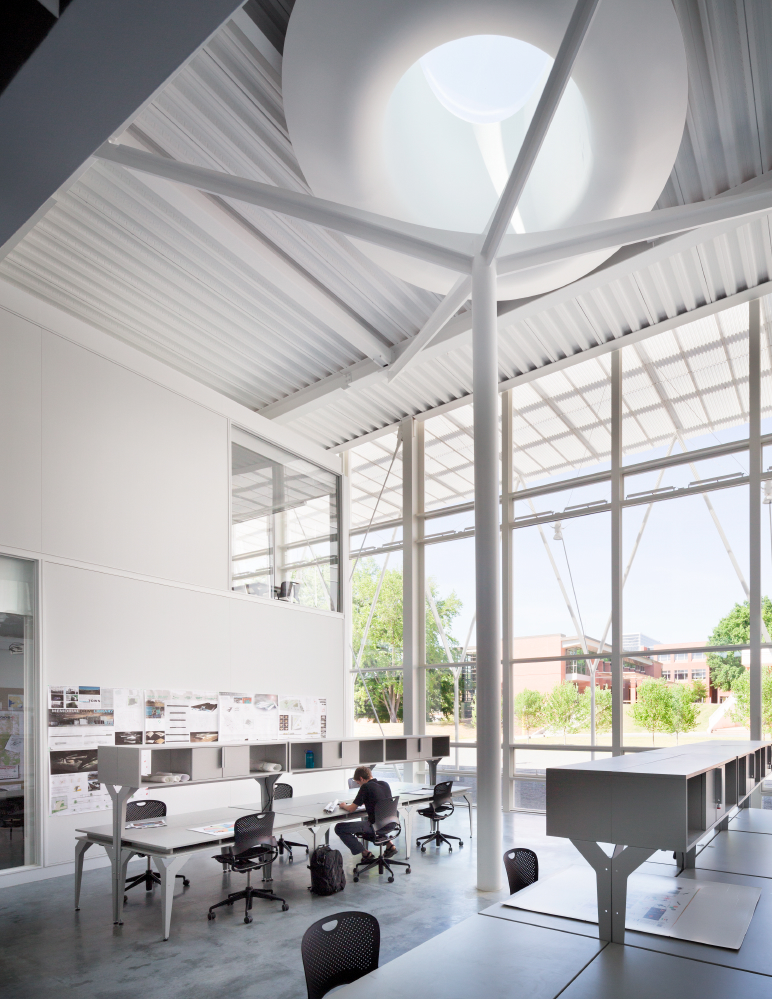
Located in upstate South Carolina, on the Clemson University campus in the Blue Ridge Mountains, a new steel-and-glass addition to the Lee Hall College of Architecture provides generously daylit spaces for students and faculty.
The 55,000-square-foot (5,100-square-meter) building was designed by Thomas Phifer and Partners as a highly energy-efficient facility that intermingles the studios, classrooms, and offices of four major departments in response to the close-knit community of the school.
 |
| Front facade of Lee Hall. Photo: Scott Frances |
The building's metal roof structure is supported by a forest of branched steel columns and its long, main facade is almost entirely glazed. The main facade, together with round skylights spaced across the roof and a consistently white interior finish, help to reflect daylight deep into the building.
|
|
King's Cross Central, a mixed-use development by Wilmotte & Associates is now under construction. Image: Wilmotte & Associates
|
Construction has begun on King's Cross Central, a 50,000-square-meter (540,000-square-foot) mixed office and retail development adjacent to London's recently renovated St. Pancras and King's Cross railway stations. The London office of Wilmotte & Associates, designed the £80-million-project for BNP Paribas Real Estate UK.
The building is being built on a site bounded by the German Gymnasium and the Stanley Building, in addition to St. Pancras Station. Once complete, the development will comprise 37,500 square meters (404,000 square feet) of office space over ten floors, and 17,500 square meters (188,000 square feet) of retail across the ground and lower ground floors.
|
|
The atrium of King's Cross Central. Image: Wilmotte & Associates
|
|

|
|

+Paul+Zanre+Photography.JPG)


+Chris+Humphreys.JPG)

DanielHopkinson_12154.JPG)


.JPG)

.665.jpg)